Google Analytics 4 properties: 3 account structure considerations
For marketers involved in Google Analytics, measuring events, campaigns and conversions in the interface will sound familiar. However, there’s another area one click away that gives opportunities to support data collection and analysis.
The “Admin” screen is usually frequented by analytics practitioners and those implementing data collection, but there are marketing benefits to getting familiar with the features available.
Exploring Admin capabilities involves the consideration of property settings for account governance, attribution, reporting enhancement and overall user tracking.
Below are three things to know and keep in mind about Google Analytics 4 account governance.
What are properties in GA4?
In Google Analytics, a property is where the reporting on web or app data collection is located. Right now, there are two different types of properties — Google Analytics 4 and the previous version of GA, Universal Analytics (sometimes referred to as “GA3”). The latter version will sunset and stop accepting data by July 2023, so all marketers should be migrated to GA4 or in the midst of migration.
As a tip, you can determine if it’s the old version by looking at the property ID. The ID is visible under the property name in the main dropdown or in parentheses in the Admin > Property column.
Does the number follow the letters “UA” and look something like this: UA-12345-1? If yes, that means that it is not a GA4 property.
Universal Analytics property IDs are tracking IDs. So, that ID would go on the website or in a tag manager to collect the data.
It’s important to know that the data source should be reviewed or added if you see any missing data or broken tracking. The number to request for GA4 is “measurement ID.”
Properties aren’t just about base measurement and they do much more than house the data and reports in GA4. Property settings and governance can affect remarketing capabilities, data integrity and even interpreting conversions.
Dig deeper: Getting started with Google Analytics 4 (Tools and resources)
How account structure relates to measurement strategy
Account structure is the foundation of a reliable and actionable analytics implementation. Decisions around where data should flow into which properties affect the analysis of the user journey. This is why it’s important to have an understanding of how properties work with each other.
When dealing with only one website or app, it’s typically straightforward and only involves creating a single data stream for a single property. For multiple websites and apps, websites with multiple domains and Google Analytics 360 customers, there are more great features to keep in your back pocket.
If a website has different domains (such as www.exampleA.com and www.exampleB.com), it’s essential for marketers to make note of where the data is and why. This is a step where things can go wrong, resulting in a drop in data integrity.
There are three questions to solve with the knowledge of how users are expected to move between sites along with how team members are going to get the most out of GA4.
1. Will users navigate back and forth between the domains as part of the web experience?
If not, no action is necessary for this part and data can (and should) be in separate properties.
If yes, the domains must be in the same property. If you find yourself navigating to two different properties for reports, what’s called cross-domain tracking needs to be enabled. With GA4, it can be a low level of effort.
Next steps to do or request:
- Make sure all data goes to one property with one measurement ID.
- Check Admin > Property > Data Streams.

- Then, navigate to the data stream mentioned earlier in the article and simply add your domains. The screen should look like this:
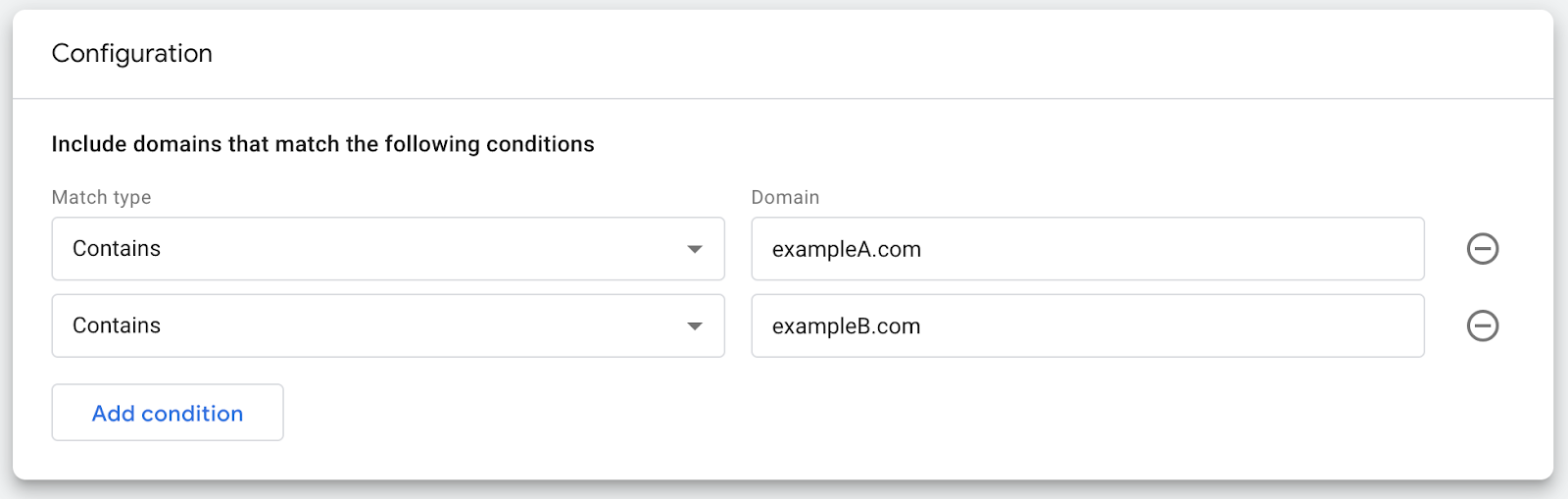
Note: This includes PayPal since the user flow will likely come back to your site after payment in most cases.
2. Would it be better and more efficient to incorporate a feature that allows for more granular data available in the account structure?
(For those who are familiar with Universal Analytics, this could be thought of as a replacement for Views. ***360 paid customers only. Your Google Partner vendor can provide guidance or assistance, if needed.)
Almost all organizations can answer “yes” to this question. Having subsets of data might be useful for:
- Making a different interface for a section of the site and content.
- Splitting by teams so they have their own custom interface.
- Separating conversion settings and Ads Links.
The next step only involves Google Analytics and not technical or implementation work. Subproperty creation is in the same area where regular source properties are (Admin).

3. Is there an opportunity to aggregate data from multiple GA4 properties into a holistic rollup property?
On the other hand, there may be opportunities to take more than one regular property and do the opposite subproperties by rolling them up to a holistic rollup property.
This enablement just involves creating the rollup property type and selecting which existing properties you’d like to include in the same admin area as the subproperties.
(***360 paid customers only. Your Google Partner vendor can provide guidance or assistance, if needed.)
Property settings can enable more data and activation
Other Admin capabilities are also in the properties area. For media metrics and audiences, integrations are essential. Linking Google Ads to Google Analytics 4 should be one of the first steps in migration or a refreshed measurement strategy. In the same Admin area mentioned above, the integrations are located at the bottom of the property column.
To link, no tracking changes are needed and it is self-serve. The prerequisites are having the Edit role in GA4 and the role of Administrator in Google Ads.
The Ads account will show up on the integration screen and everything is good to go. Audiences created in Google Analytics will be available in Ads automatically.
You will also have to check to make sure that the toggles are enabled for Google Signals and Ads Personalization on the same Admin screen where the other former steps are located (Admin > Data Settings).
If they are off, you may want to double-check with whoever is the administrator of GA (if it’s not you) to make sure that it is okay to use these settings in alignment with your privacy policies.
Make meaningful improvements to your analytics
There will be edge cases to any implementation, but the above topics and questions should kickstart more collaboration between marketers and analytics for meaningful improvements.
Having data in the right place, in addition to tracking correctly with enablement for media, will open up opportunities for valuable audience creation.
It might seem like many steps. But just a few settings, toggles and reviews of the properties can have a payoff for decision-making and analytics involvement for marketers in Google Analytics 4.
Catch up on the entire series:
Opinions expressed in this article are those of the guest author and not necessarily MarTech. Staff authors are listed here.

About The Author
Samantha has been working with web analytics and implementation for over 10 years. She is a data advocate and consultant for companies ranging from small businesses to Fortune 100 corporations. As a trainer, she has led courses for over 1000 attendees over the past 6 years across the United States. Whether it’s tag management, analytics strategy, data visualization, or coding, she loves the excitement of developing bespoke solutions across a vast variety of verticals.